Can the kitchen be an emancipatory space for women?
To prepare an argument about whether the kitchen can be an emancipatory space for women, begin by gathering the key ingredients.
Start with one enduring image: the kitchen as a sight weighed down by the heat of unpaid labour, its walls seasoned with expectations of service and sacrifice. Add Emma Goldman’s definition of emancipation, a reminder that freedom is not simply legal or economic, but the ability for a woman to become fully human and equal, loosened from customs and prejudice (Goldman, 1910). Next, fold in Bell Hooks’ ethics of care and love as a framework, where love functions not as decoration but as a radical, necessary force (Hooks, 2000). This is a binding agent that holds communities together and is necessary for resistance. Mix this carefully with Hooks’ idea that love is political, not just a private indulgence. This blend will structure the argument: the idea that care and love, when mobilised intentionally, can transform labour into a practice of freedom. Now, introduce two key case studies where food is used as a weapon of activism: the Shaheen Bagh protests and the Miners’ Wives communal kitchens in South Wales. Here, women transformed ordinary acts of cooking into a slow-burning site of resistance. Their kitchens were not domestic cages but communal places, warming bodies and nourishing activists, sustaining defiance through shared labour. Finally, bring all ingredients to a simmer; this essay argues that the kitchen can indeed become an emancipatory space for women, but only under specific conditions. It requires turning care from a gendered expectation into a deliberate act of resistance, transforming cooking from a duty into a weapon, and using food to nourish both bodies and collective struggle.
Emancipation is a multifaceted and layered concept; its meanings shift depending on who defines it, from where, and for what purpose. When thinking about women’s emancipation, whether it unfolds inside or outside of the kitchen, the definition which resonates most strongly with me and will shape my analyses comes from Russian activist and revolutionary Emma Goldman, whose writing refuses the administrative version of freedom that liberal feminism often settles for. Goldman passionately insists that true emancipation should make it possible for a woman to be ‘human in the truest sense’ (Goldman, 1910; 2). This forces us to look beyond a patriarchal story of emancipation, along with legal reforms or economic access. This definition demands to break free from the deeper traditions that govern women’s lives: the prejudices, inherited customs, and the expectations that confine women to gendered forms of care and unpaid labour. Under this lens, emancipation becomes a process of loosening. Loosening the grip of norms that frame domestic labour as natural and the cultural scripts that tie femininity to invisible service. I see emancipation as a refusal to accept the kitchen as a predetermined site of subordination, and an invitation to reimagine it as a place where women can adopt their own agency. Goldman’s idea encourages us to ask what the kitchen itself can become once its meanings and traditions are resisted or reclaimed. In this sense, emancipation is not in the absence of constraint alone, but the active reconfiguration of space and roles that once held women in place.
Traditionally, scholars argue that the kitchen has symbolised everything women’s emancipation is not. Federici (1975) argues that housework is not simply unpaid labour but a form of exploitation that has been naturalised through the ideological construction of women as inherently suited to domesticity. The figure of the ever-smiling, self-sacrificing housewife is not an innocent cultural trope; it functions to depoliticise housework, obscuring the fact that this work sustains the very social and economic systems that make it invisible. As domestic labour is often mystified as a ‘natural attribute’ of femininity, capitalism displaces political conflict onto personal identity, restricting women’s agency while simultaneously depending on their labour to reproduce the conditions for others to study, organise, protest and participate in public life. If reproductive labour is essential for the functioning of society, then its performance is never private. Similarly to Goldman, Federici passionately describes that being identified as a housewife would be ‘worse than death’ (Federici, 1975: 75). ‘The housewife’ is a symbol of housework not being recognised as a social contract, and to convince women that tending to their families’ needs is the most she can expect from herself, and life. Contrastingly, this need for care doesn’t need to just be a masquerade to hide the need for wages for housework; it can also be radicalised as something to be needed for emancipation.
Hooks’ (2000) interpretation of love as a radical, political act furthers this point. When using this as a lens, we can argue that care can be reclaimed from its domestication and changed into a deliberate practice of emancipation, rather than an expectation of feminine servitude. In this sense, gendered labour does not become emancipatory because it is loving; rather, it becomes emancipatory when love and care are mobilised consciously and collectively, disrupting the capitalist logic that isolates women in the private sphere and rendering cooking as a site of political possibility.
A powerful example of how the kitchen can become an emancipatory space, where love and care are rooted in freedom, is found in the Shaheen Bagh protests of 2019. A group of elderly Muslim women (figure 1) fought tirelessly to protest the state violence inflicted on the students who resisted the Citizenship Amendment Act (CAA). Their participation highlighted the double burden they carried: alongside political resistance, they still had to navigate the unpaid care responsibilities expected of them, from tending to children to cooking for their families. These women not only gracefully carried out their duties as mothers and grandmothers, but they also rallied around each other and made a change.
When women are constrained to the private sphere to be responsible for child-rearing, cooking and cleaning, a classic capitalist logic of atomistic individualism emerges (Ibkar, 2024). Care becomes framed as an individual and ‘natural’ attribute of womanhood, one that is not politicised, paid or an important mechanism in society, rather than a social necessity or a form of labour. Housework has been transformed into something ‘fulfilling’ for women because it’s a labour of love, sustaining the idea that it's unimportant and unwaged (Federici, 1975).
The women of Shaheen Bagh, however, had radically disrupted this idea. They situated their labour in the kitchen in a political context, rooted in the ethics of love and care to sustain autonomy and liberation. The ethos of mutual care that these women possessed kept the protest alive. Ibkar (2024) explains that even though a protest may be the furthest thing from feeling at home, the women carefully divided duties of care to make sure the tent and everyone’s stomachs were never empty. There was a huge void left by children who had been uncaringly subjected to violence in the aftermath of the original protests against the CAA. Although this was a dangerous and painful sit-in protest, these women claimed the space as their own and used communal cooking as a weapon of care for each other and against the government. Lola Olufemi (2024) builds on this narrative by carefully putting forward the idea of the kitchen not only being a site full of gendered acts of service, but part of an engine which maintains life. Olufemi calls for a more integrated approach to the kitchen and to recognise that it’s intimately tied to our social condition and our capacity for transformative action (Olufemi, 2024). I agree with Olufemi in that the reason the Shaheen Bagh protest was so successful is that these women made the informed choice to resist the idea of kitchens being places of domination. Joint preparation of meals is a way to bring people together and nourish activists, a way to show you can’t have resistance without care and love, even amid marginalisation.
Importantly, the actions of these women also exposed that unpaid domestic labour is never experienced by all women in the same way. The protesters were predominantly elderly, Muslim, and of a lower caste. As they were already positioned at the intersections of gender, class, religion and age, they were the most affected by state neglect and marginalisation. Their daily kitchen labour was not simply gendered; it was shaped by Islamophobic narratives that mark Muslim women as oppressed by classed assumptions that poorer women absorb the heaviest domestic burdens. The Shaheen Bagh kitchen thus became a site where intersecting inequalities were confronted, not reproduced. Patricia Hill Collins ' (1990) framework of ‘interlocking systems of oppression’ further illustrates this dynamic. These women’s experiences of domestic labour must be understood as a part of a matrix in which gendered, racialised, and classed and caste – based oppressions reinforce one another. In this case, this intersectional approach further argues that these women were not only fighting for one kind of justice, but many. This defies the idea of the subservient woman, who devoted her life to cooking and cleaning – these women proved that emancipation is possible when you use communal cooking as a weapon to do so.
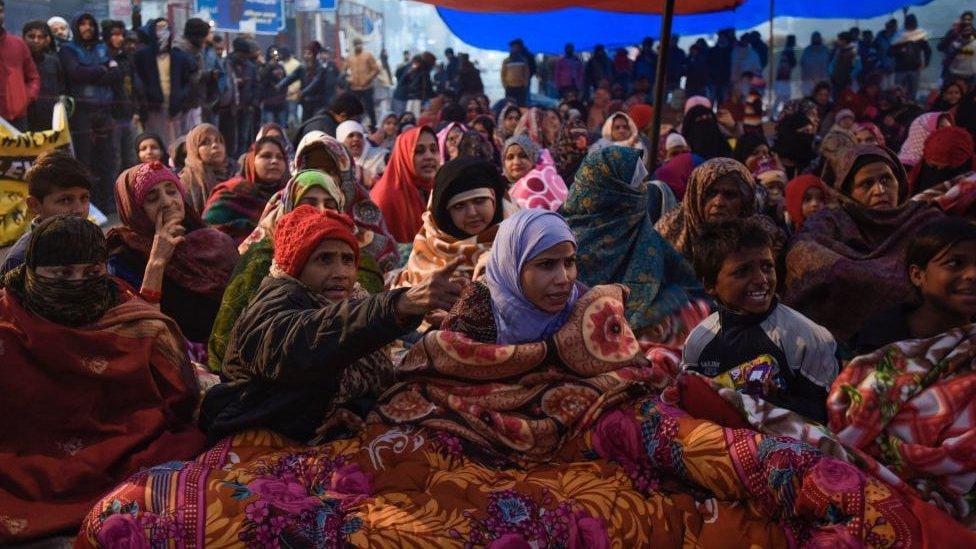
Fig 1: The Shaheen Bagh protest, 2019, BBC
Bell Hooks’ thoughts on the ethics of care illustrate why the Shaheen Bagh protest became a site of women’s emancipation. For Hooks (2000), love is not a private emotion but a radical practice of freedom; a political decision to nurture one another to achieve survival in the face of domination. In this example, it was to keep everyone under that tent for as long as possible so they could stand up for what was right by sharing their labour, transforming cooking from an isolated duty into a shared practice. Ibkar (2024) contends that the women never left their homes because they took their homes with them. Their care work did more than feed bodies; it created the material and emotional conditions that made resistance possible. Moreover, their action exemplifies Goldman's (1910) vision of emancipation as the process through which women reclaim their humanity by breaking free of restrictive customs. By using food as a weapon of solidarity, nourishment, and defiance, the Shaheen Bagh protesters turned the kitchen into a space where love enabled freedom and where care became the ground on which women could act autonomously and collectively, achieving emancipation within the kitchen.
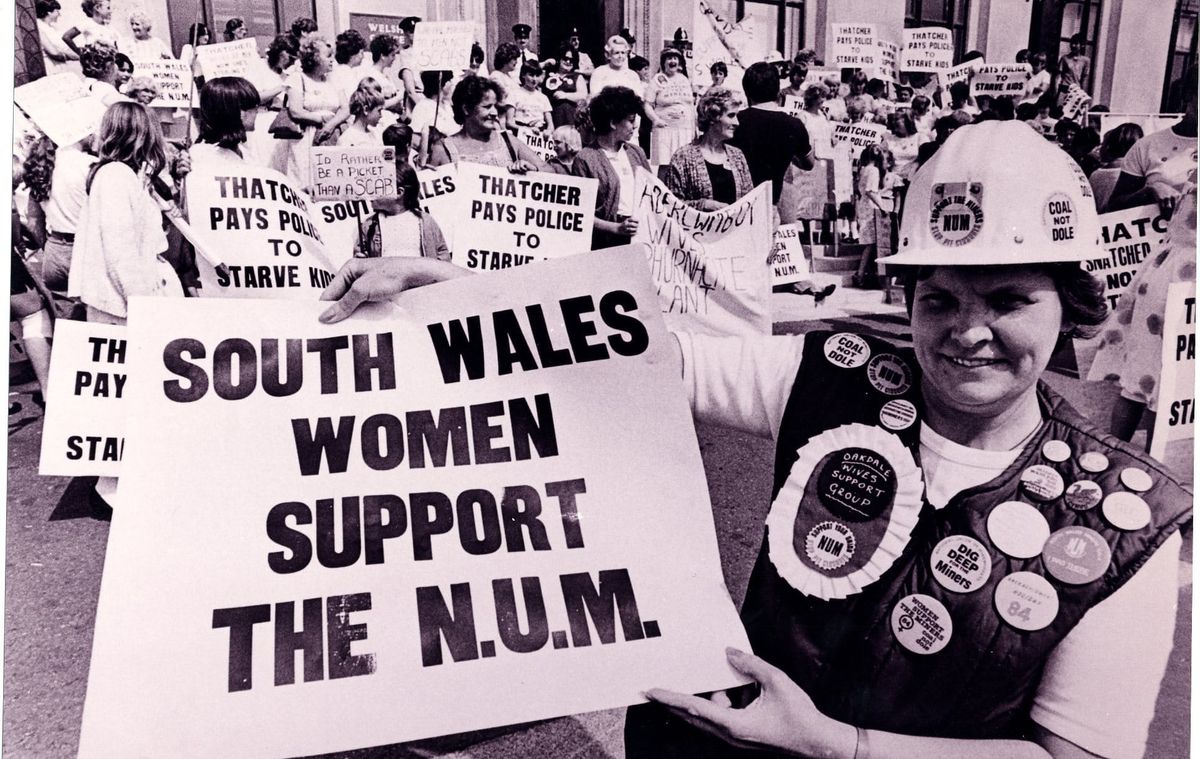
I will now move on to an example of the collective feeding in South Wales during the general strike and miners’ lockout in 1926 (Bruley, 2007). Here, the idea of nourishing activists to effect change remains poignant. Deep community resilience against the wage cuts and poor conditions resulted in a six-month struggle, which became a defining event in the labour movement. Working-class women, living in poverty and excluded from formal political sites, organised vast cooking operations that fed entire mining communities, causing the strike to continue and making it materially possible. This labour, often carried out in church halls, classrooms and makeshift canteens, formed what Bruley (2007:17) calls a ‘new discourse of housewifery’: one in which everyday cooking skills were transformed into a strategic, collective infrastructure. These communal kitchens mirror the image of the invisible housewife whose work silently keeps the world running, yet in this context, the work’s political necessity becomes impossible to ignore. Mining communities at the time were defined by deeply entrenched, rigid views about the sexual divisions of labour. Men were recognised as the breadwinners, heavily involved in the public sphere, while women’s contribution was confined to the private sphere and devalued as merely “supporting” the class struggle. As historians note, ‘Male bonding’, such as choirs, allotments, sports and female subordination, were regarded as a huge part of the class struggle at this time. Through the lens of Frederici (1975), the labour of the minor’s wives was economically exploited – unpaid, feminised and necessary. Although, Nancy Fraser (2000) interestingly points out that the way you recognise these roles is crucial and helps us to shift this frame. Although this domestic labour was not symbolically recognised as political, it was materially crucial to sustaining the strike. Once we reconceptualise their domestic labour as political action, it no longer sits in the devalued, feminised category that Friderici critiques. Instead, it becomes both materially and politically generative, somewhere women can exercise agency and reshape the position of struggle.
Indeed, “men and women worked together in public life as never before” (Bruley, 2000). The communal kitchens enabled women to be able to emerge into the public sphere for the first time, whilst also radicalising cooking into a weapon of solidarity. This was a significant breakthrough in a patriarchal context where marriage was often closer to a labour contract than a voluntary partnership of love. Hooks’ (2000) perception of love as a necessity for political action and solidarity further illustrates this. Without the community bonds and care practices being cultivated in the kitchens, the protest could never have been sustained. Similarly, Fisher and Tronto (1990) argue that caring has been socially devalued by capitalist and patriarchal structures. This makes it difficult for women to be seen as active agents in the public and political spheres. Although when this care is collectivised rather than isolated, such as women in nuclear families being separated from the community, domestic labour can be politically recognised. In this way, miners’ wives used kitchen labour not to retreat into domesticity, but to enter public life and assert political agency.
This collective reworking of care aligns with Emma Goldman’s definition of emancipation as the refusal of inherited customs and constraining traditions. The women in South Wales were not emancipated by the kitchen as a space, but as their reimagining of domestic labour as a communal, strategic, and resistant practice. Moreover, this case study shows that the kitchen can be an emancipatory space for women, but only when they refuse its traditions of gendered labour and repurpose it towards political practices. Emancipation emerges not from the space itself but from the women collectively reimagining care as resistance.
When viewed together, the Shaheen Bagh protest and the South Wales communal kitchens reveal that domestic labour becomes emancipatory only when it is collectivised, politicised and consciously reclaimed from the traditional systems that normally devalue it. The women of the Shaheen Bagh bringing their homes to the tent, and the minors’ wives’ actions being called a ‘new discourse of housewifery’ are both examples of women weaponising food for freedom. Although the conditions and meanings of their actions diverged in various ways, both groups of women transformed cooking from a private, isolated obligation into a shared political practice that materially sustained resistance movements. For the miners’ wives in 1926, communal cooking and soup kitchens successfully disrupted entrenched patriarchal divisions between private and public spheres, thus enabling them to enter political space for the first time. This clearly demonstrates Fraser's (2000) argument that once domestic labour is recognised as a driver of political change, it no longer sits in the devalued, feminised category of social confinement, which Federici critiques. Moreover, The women of the Sheheen Bagh, already positioned at the intersections of gender, class, religion, and age, and at the front lines of political action, mobilised care as a radical ethic of love (Hooks, 2000) and as a counter-narrative to Islamic constructions of Muslim women as passive or oppressed. Where the miners’ kitchens challenged classed and gendered boundaries, the Shaheen Bagh kitchen challenged racialised, religious and gendered ones simultaneously. However, in both cases, the kitchen became a space where women collectively undermined the traditions that confined them to undervalued labour. In political nourishment, and using food as a weapon, they transformed the kitchen from a site of subservience into a mechanism of autonomy, solidarity and resistance. This demonstrates that under certain conditions, the kitchen can indeed function as an emancipatory space for women.
Overall, in this essay, I have mixed together the evidence that the kitchen can be an emancipatory space for women, but this only happens when its usual meanings and power relations are altered. In the conventional forms, as feminist scholars like Silvia Federici (1975) argue, the kitchen is tied to unpaid, traditional forms of labour, which is depoliticised if it’s left to simmer unnoticed. When this is left unchallenged, it reinforces the very structures that have limited women’s agency. However, when domestic labour is detached from expectations of isolated feminine duty, its function shifts entirely. Both case studies demonstrate how this transformation can be cooked into reality. At Shaheen Bagh, elderly Muslim women drew on Hooks (2000) ethics of care and love to sustain a political stance in the face of violence. Their communal kitchen resisted Islamophobic and gendered narratives by asserting care as a radical practice. In South Wales, the miners’ wives used communal cooking to sustain a major labour struggle, revealing through Fraser's (2000) lens that when you change the perception of private labour, it can become politically indispensable when brought into the public sphere. Both contexts taught me that the kitchen did not become emancipatory because of its walls, but because women reimagined the recipe of what could be done within it. What generated emancipation was never the act of cooking itself, but the radical re-seasoning of what care could mean: a strategic practice to bind communities together. For this reason, the kitchen carries no fixed politics of its own. Its meanings depend entirely on how that labour is valued and whether it remains invisible. When women refuse the traditions that confine them and organise collectively, the kitchen can indeed become an emancipatory space - one where care fuels resistance, where love becomes political, and where women carve out new forms of agency from the very labour once used to restrict them.
References
Bruley, S., 2007. The politics of food: Gender, family, community and collective feeding in South Wales in the general Strike and Miners’ lockout of 1926.
Collins, P.H., 1990. Black feminist thought in the matrix of domination. Black feminist thought: Knowledge, consciousness, and the politics of empowerment, 138(1990), pp.221–238.
Federici, S., 1975. Wages against housework (pp. 1972–1977). Bristol: Falling Wall Press.
Fisher, B. and Tronto, J., 1990. Toward a feminist theory of caring. Circles of care: Work and identity in women’s lives, 7(5), pp.35–92.
Fraser, N., 2000. Rethinking recognition. New Left Review, 3, p.107.
Goldman, E., 1910. The tragedy of woman's emancipation (pp. 12–16). Mother Earth Publ. Assn.
Hooks, B., 2000. All about love: New visions.
Ibkar, A., 2024. Performing Radical Care: The Muslim Grandmothers of Shaheen Bagh. Theatre Journal, 76(4), pp.453–473.